
How Many Hors d’Oeuvres Per Person? Your Essential Guide
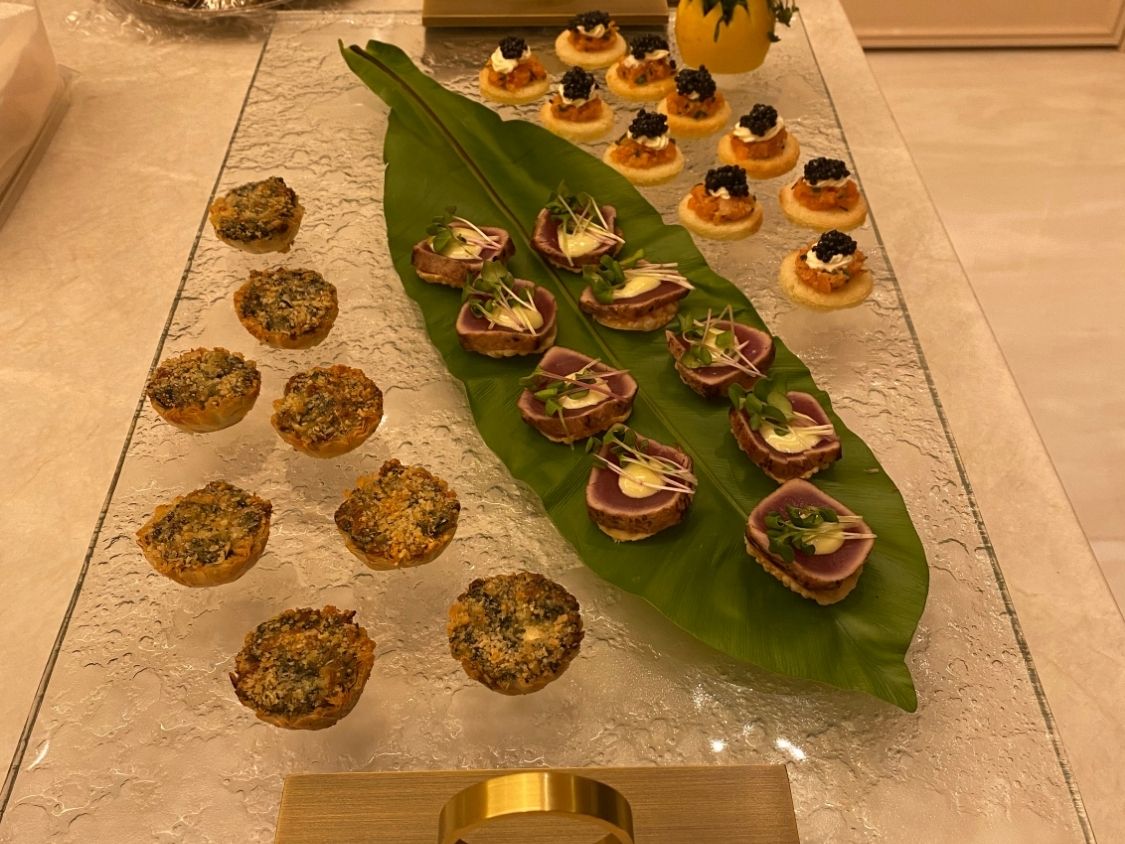
Seared tuna on a banana leaf, herb tartlets, and caviar blini from a Manhattan event I styled.
This post may contain affiliate links. As an Amazon Associate, I earn from qualifying purchases, at no extra cost to you.
How many hors d'oeuvres per person should you plan? Aim for 4 to 6 hors d'oeuvres per person for a one-hour cocktail hour before dinner, 8 to 10 pieces for a two-hour reception, and 12 to 15 pieces for a standalone cocktail party with no meal. Offer a mix of passed and stationary bites, keep every piece to one bite, and always serve items guests can eat without a knife or fork.
A sprawling lawn in the Hamptons, just as the sun begins to dip, is a stylist's dream. For a host, it can quickly become a logistical nightmare.
I was working a mid-summer event at a residence in Water Mill, out in the Hamptons, watching servers carry out trays of what looked like edible jewelry. The hors d'oeuvres were stunning, but they were a disaster. Guests were trying to balance a wine glass, a cocktail napkin, and a tiny, dripping crostini while shaking hands. I watched one guest spend three solid minutes trying to figure out how to eat a shrimp cocktail without looking like a mess.
That was the moment I realized: serving hors d'oeuvres is not about the recipe. It is about the physics.
After years of working high-end events and hosting my own dinner parties in Brooklyn, I have seen the same mistakes in luxury lofts and tiny apartments alike. We get so caught up in making food look perfect that we forget the guest only has two hands, and one of them is already holding a drink.
Good hors d'oeuvres service is an art of subtraction: removing the awkwardness, the extra napkins, the "how do I eat this?" anxiety. From knowing how many hors d'oeuvres per person to plan, to styling a tray that actually works, here is everything I have learned about getting hors d'oeuvres right.
How Many Hors d'Oeuvres Per Person? The Professional Formula
The internet will tell you "6 to 8 pieces per person" and leave it at that. Even Michelin-starred chef Daniel Boulud's often-quoted rule stops at a single number. At professional events, the calculation is never that simple. The number depends on three things: how long your cocktail hour lasts, whether dinner follows, and how heavy each piece is.
Cocktail hour length · dinner or no dinner · how heavy each piece is. Every professional calculation starts from these three, never from a single magic number.
This is the framework I learned working events, adjusted for a home host.
Pre-Dinner Cocktail Hour (1 Hour)
If a full dinner is coming, hors d'oeuvres are a warm-up, not the main event. Plan 4 to 6 pieces per person. You want guests satisfied but not full before they sit down.
A good split: two passed items and one stationary display, like a cheese board or crudités tray.
Extended Cocktail Reception (2 to 3 Hours)
For longer receptions where dinner still follows, increase to 8 to 10 pieces per person. Add one or two heartier options (think dumplings, sliders, or skewers) to carry guests through the extra time.
Standalone Cocktail Party (No Dinner)
When hors d'oeuvres are the entire meal, plan 12 to 15 pieces per person. This is where most home hosts underestimate. Guests always eat more than you think. Always.
Build your menu around at least 4 to 5 different items so the table does not feel repetitive by hour two.
| Event Type | Duration | Per Person | 6 Guests | 10 | 15 | 20 |
|---|---|---|---|---|---|---|
| Pre-dinner cocktail hour | 1 hr | 4–6 | 24–36 | 40–60 | 60–90 | 80–120 |
| Extended reception | 2–3 hrs | 8–10 | 48–60 | 80–100 | 120–150 | 160–200 |
| Standalone cocktail party | 3+ hrs | 12–15 | 72–90 | 120–150 | 180–225 | 240–300 |
Swipe to see all guest counts →
Passed vs. Stationary: How to Choose Your Service Style
At professional events, hors d'oeuvres come out two ways: passed on trays by servers, or set out on a table for guests to help themselves. Most home hosts default to stationary because it feels easier. But the best approach for a home party is almost always a combination of both.
Passed Hors d'Oeuvres (Tray Service)
Passed means you or a helper carry a tray around the room, offering bites directly to guests. This works beautifully for hot items that need to be eaten immediately (like dumplings or warm crostini) and for the first 20 minutes of a party when guests are still arriving and haven't found the food table yet.
You do not need a team of servers. One person walking a tray through the room twice in the first half hour changes the entire energy of a party.
Stationary Displays (Boards and Stations)
A stationary display is anything guests can walk up to and serve themselves: a cheese board, a crudités tray, a slate board with canapés. This is the backbone of home entertaining because it works while you are busy greeting guests, pouring drinks, or finishing something in the kitchen. If you already know your table setting essentials, think of the stationary board as the cocktail-hour version of the same logic: everything in its place before the first ring of the doorbell.
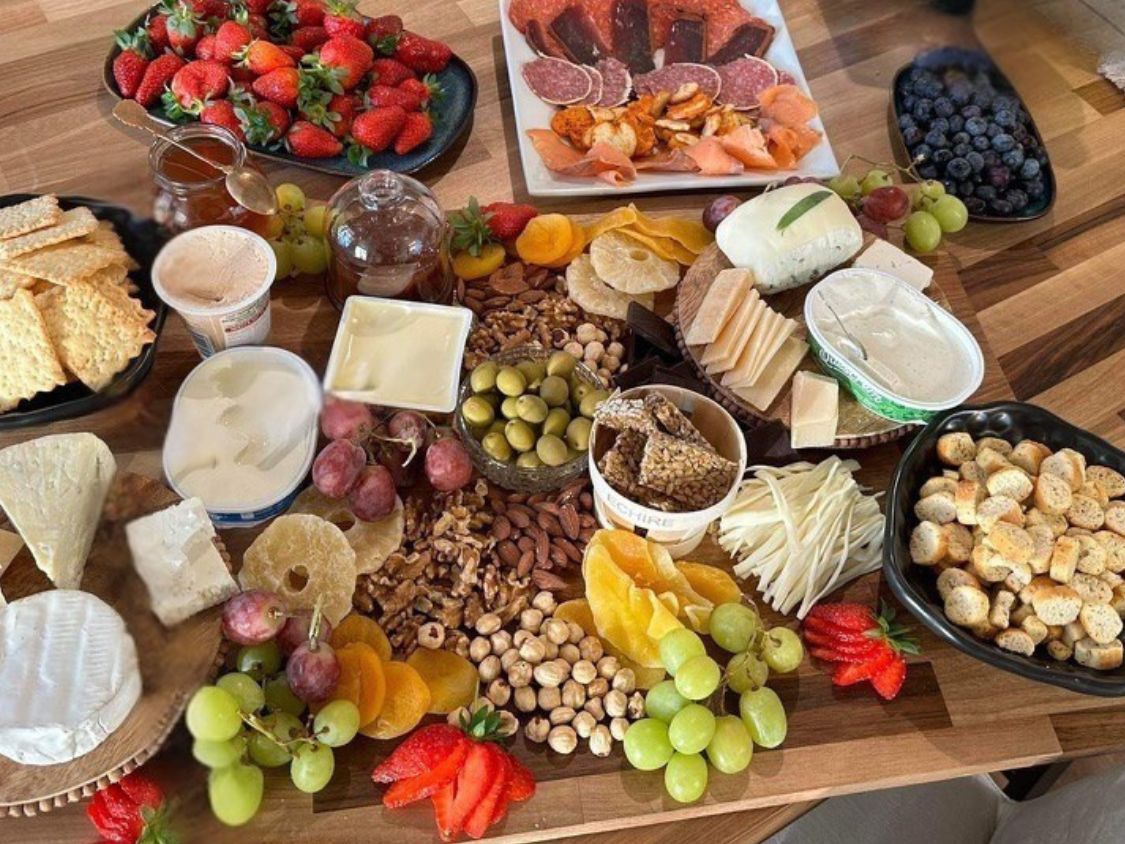
A stationary grazing board works while you greet guests and pour drinks.
The key is placement. Set your stationary display where guests naturally gather, not tucked in a corner. A kitchen island or a console table near the entrance works better than a dining table people have to seek out.
The Best Combo for Home Entertaining
At my own dinner parties, I set out one stationary board 10 minutes before guests arrive, then pass one hot item by hand during the first 20 minutes. That's it. Two moves.
This gives you the polished feel of a catered event without the stress of running trays all night. Your guests get variety (cold and hot, self-serve and personal), and you get to actually enjoy your own party. If you are planning the full evening, my guide on how to host a dinner party walks through where the cocktail hour fits in the larger arc of the night.
Serving hors d'oeuvres is not about the recipe — it is about the physics.
Tray Presentation and Styling (The Details That Elevate)
The difference between hors d'oeuvres that look homemade and hors d'oeuvres that look styled comes down to a few small decisions on the tray.
The One-Bite Rule
Every piece on your tray should be one bite. Not two bites, not "one big bite if you really go for it." One clean, comfortable bite. This is the single most important rule in professional hors d'oeuvres service, and the one home hosts break most often. Classic etiquette guides like Emily Post approach the same problem from the guest's side; the host's job is to make their advice unnecessary.
If a guest has to bite something in half and hold the dripping remainder while making conversation, the food has failed its job. I learned this watching that shrimp cocktail struggle in Water Mill. When in doubt, make it smaller.
Spacing and Layout
Professional trays are never crowded. Leave at least an inch between each piece so guests can pick one up without touching three others. Arrange items in clean rows or a simple pattern rather than piling them on.
A tray of 12 well-spaced bites looks more elegant than a tray of 25 crammed together. White space on a platter works the same way it does on a page: it makes everything around it look intentional.
Cadence: How Often Trays Should Move
This is the detail nobody writes about, and it is the first thing you notice at a professionally run event. A passed tray holds 10 to 12 pieces when one person is carrying it. More than that and the tray gets heavy, the arrangement collapses, and guests hesitate to take the last few.
The refill rule: a tray goes back to the kitchen when about a third of the pieces remain. A half-empty tray reads as leftovers. A freshly arranged one reads as abundance. Same food, completely different signal.
At home, this translates simply. Load small, refill often. Two smaller passes always beat one overloaded tray.
The Garnish Trick
A single visual anchor in the center of your tray pulls the whole presentation together. At events, we use a small herb bundle, a hollowed lemon filled with microgreens, or a few edible flowers placed at the center of the platter. It takes 30 seconds and turns a plate of food into a styled moment.
The glass tray in the photo below came from a Manhattan event I styled: a carved tomato filled with fresh herbs, set between rows of tartare crisps and caviar blini. The banana leaf under the seared tuna is the same idea in a different mood.
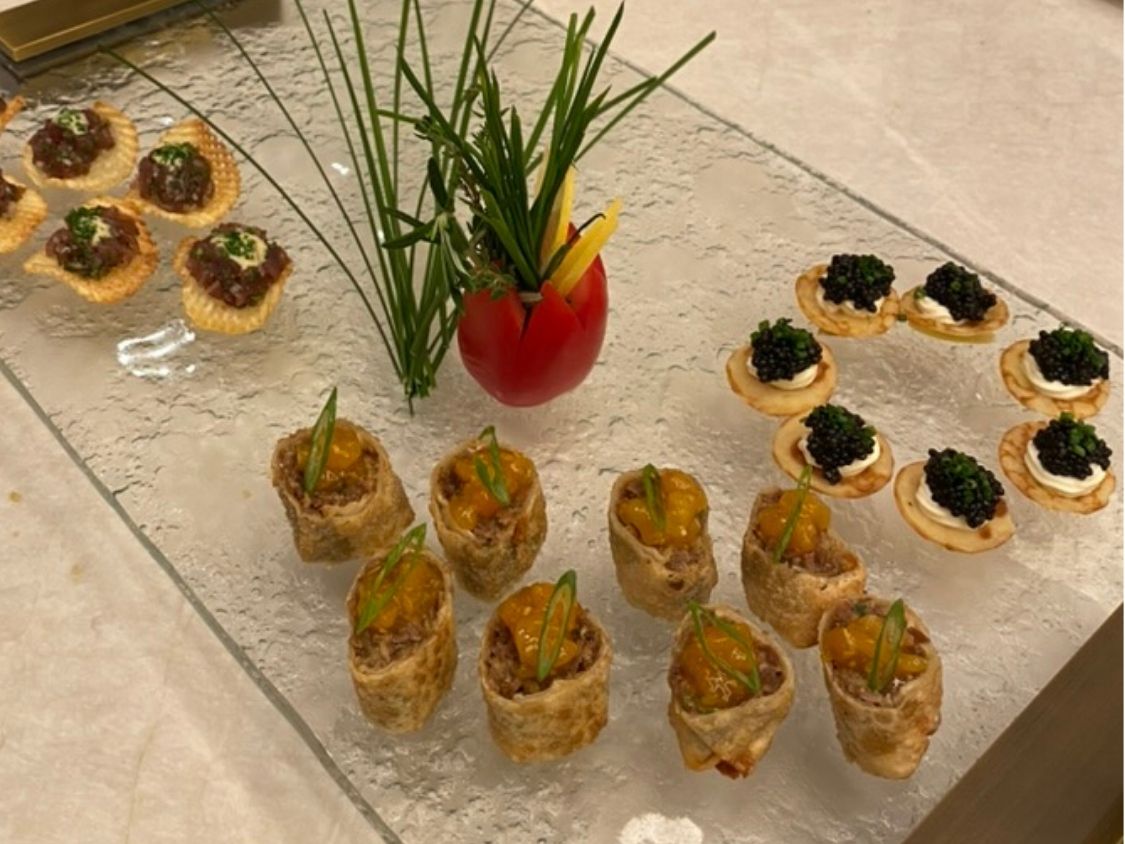
A carved tomato filled with fresh herbs anchors three types of canapés on one tray.
One tray, one garnish. A single herb bundle or carved vegetable at the center does more styling work than a decoration next to every piece.
What to Serve: Building a Balanced Menu
The most common mistake I see is a table full of the same category. Five different cheeses and nothing hot. Or four types of bruschetta and no protein. A balanced hors d'oeuvres menu works in threes.
The 3-Category Rule (Hot, Cold, Neutral)
Hot: Dumplings, warm crostini, mini quiches, stuffed mushrooms. These create a sense of occasion and give guests something substantial.
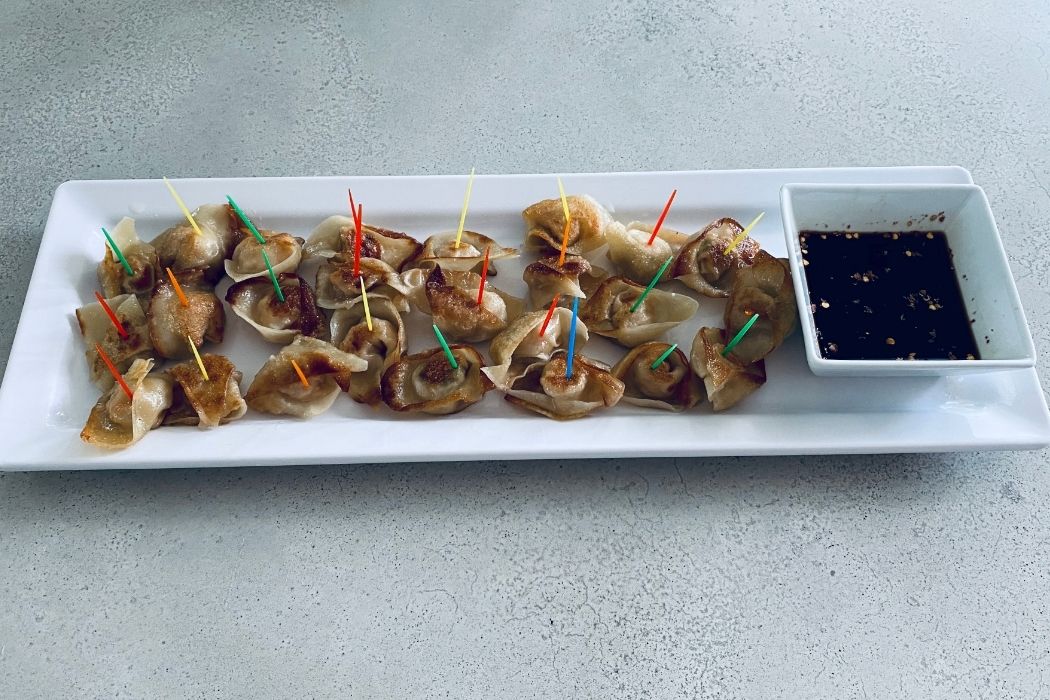
Cocktail picks turn any hot bite into one-handed food.
Cold: Tartare on crispy rice, ceviche spoons, smoked salmon bites, chilled shrimp. These can be prepped hours ahead and set out without stress.
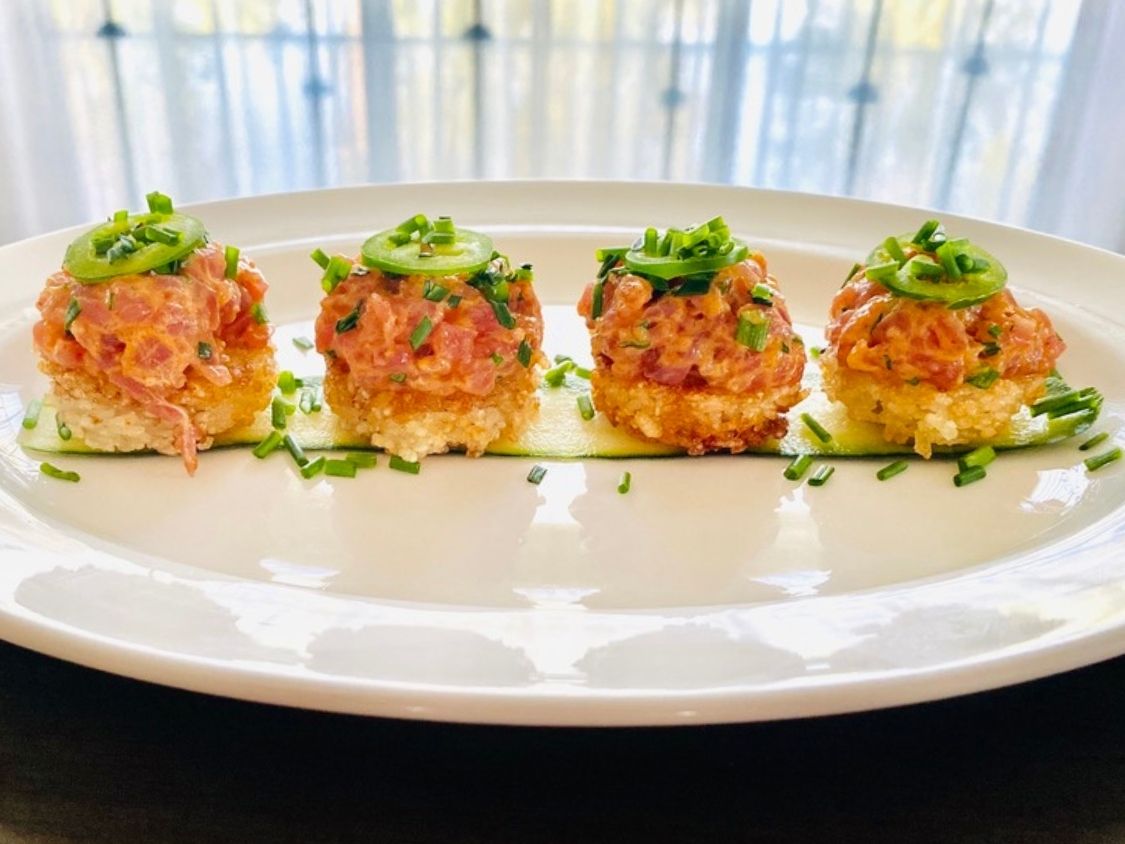
Cold hors d'oeuvres like tartare on crispy rice can be prepped hours ahead.
Neutral (room temperature): Cheese boards, charcuterie, crudités with dip, marinated olives. This is your stationary backbone. It goes out first, stays out longest, and requires zero last-minute attention.
For a party of 10 to 15, one item from each category is enough. For 20 guests, add a second hot or cold option.
Dietary Considerations Without the Awkwardness
Do not ask your guests to announce their dietary needs at the table. Build the accommodation into the menu from the start.
One plant-based option, one gluten-free, one dairy-free, and you will quietly cover most of the room. No labels. No one singled out. A crudités tray with hummus does all three at once.
At professional events, we never put allergy labels on passed trays. Instead, the person carrying the tray knows every ingredient and can answer quietly when asked. At home, the same principle applies: know what is in your food and let guests ask privately.
Common Mistakes I See at Every Event
After fifteen years of working events, the same problems show up whether the party is in a Manhattan penthouse or a Brooklyn walkup.
Serving everything at once. Your guests do not need to see the entire menu the moment they walk in. Stagger your hors d'oeuvres. Set out the stationary board first, pass the hot item 15 minutes later, and bring out a second round halfway through the cocktail hour. This keeps the table interesting and gives you control over pacing. My dinner party checklist has the full timing map for the whole evening.
Forgetting the napkin situation. If your hors d'oeuvres require a napkin (and most do), place cocktail napkins at every station, not just one stack on the kitchen counter. I keep a small pile next to every board and tray. Cloth cocktail napkins elevate the whole setup (a simple fold from my napkin folding guide works beautifully at small scale), but linen-feel disposables work just as well.
Making pieces too large. If a guest needs two bites, you have made it too big. If it drips, crumbles, or requires a plate, rethink the format. The best hors d'oeuvres disappear in one motion: pick up, eat, done.
Ignoring traffic flow. A beautiful spread means nothing if it is pushed against a wall behind a couch. Place your food where people are already standing. Kitchen islands, entryway consoles, and coffee tables all outperform a formal dining table during cocktail hour because guests do not have to go looking for the food.
Essential Serving Pieces for Hors d'Oeuvres
You do not need to invest in professional catering equipment. A few well-chosen pieces will carry you through any party.
A large flat platter (white porcelain or slate). This is your workhorse. A clean white porcelain platter makes every piece of food stand out, and a slate board adds texture when you want a more casual feel. Either one works for both passed and stationary service. If you want to invest in a premium piece, Crate & Barrel makes a slate and wood board with built-in dipping bowls that photographs beautifully.
Slate vs. white porcelain: my take
- Versatile across every event type
- Porcelain is dishwasher safe and easy to clean
- Slate takes chalk-marker labels for cheeses and canapés
- Slate requires hand washing and occasional oiling
A rectangular serving tray with a dipping compartment. Perfect for dumplings, spring rolls, or anything with a sauce. The built-in compartment keeps the sauce contained and gives guests one clean place to dip.
Cocktail picks and bamboo skewers. These turn any bite into a no-mess, one-handed food. Decorative bamboo picks add a small visual detail that costs almost nothing, and reusable stainless steel picks are the more polished, zero-waste alternative.
A round tray with a raised edge. This is your carrying tray. The raised edge keeps pieces from sliding when you walk a tray through the room. Mother-of-pearl, wood, and marble all work; Williams-Sonoma's monogrammed cocktail napkins pair with any of them if you want the setup to feel gift-worthy. Choose a tray that feels substantial in your hands.
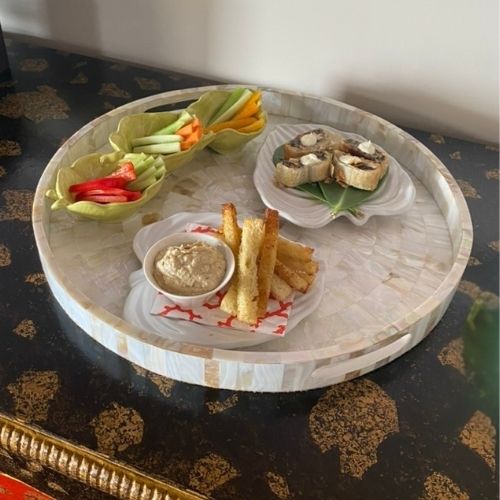
A raised-edge round tray doubles as décor on a console between passes.
Frequently Asked Questions
How many hors d'oeuvres per person for a cocktail hour before dinner?
What is the difference between passed and stationary hors d'oeuvres?
What is the one-bite rule for hors d'oeuvres?
How far in advance can I prepare hors d'oeuvres?
Do I need a server for passed hors d'oeuvres at home?
How many hors d'oeuvres do I need for 50 guests or a wedding reception?
How many hors d'oeuvres should go on one serving tray?
Back on that lawn in Water Mill, the problem was never the food. The problem was that no one had thought about the moment a guest holds a glass in one hand and reaches out with the other.
That is the whole secret to knowing how many hors d'oeuvres per person you actually need. Count the pieces, keep them to one bite, put the food where people already stand, and let a single herb bundle do the styling work. Hors d'oeuvres are an art of subtraction — what you remove is exactly what your guests will remember as ease.
Set the board out. Pass the tray once. Then go enjoy your own party.