
How to Create Ambiance for a Dinner Party
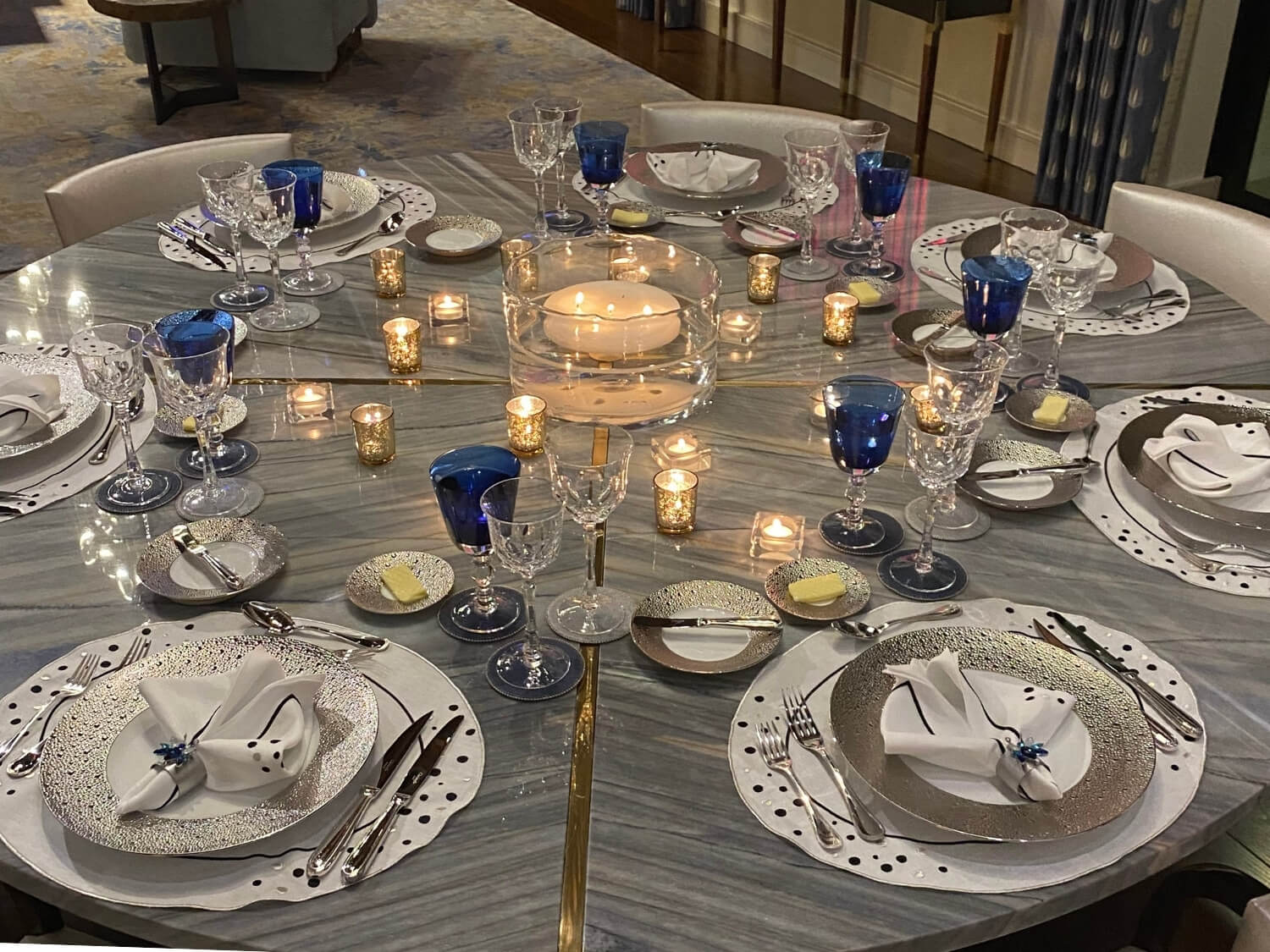
Styled by Nino Ramish — layered candlelight replaces overhead light for an intimate dinner set
This post may contain affiliate links. As an Amazon Associate, I earn from qualifying purchases, at no extra cost to you.
How to create ambiance for a dinner party: layer three elements, light, scent, and sound, as one connected system rather than separate decorations. Keep lighting between 2,700 and 3,000 Kelvin, introduce scent at least 30 minutes before guests arrive, and keep music under 90 BPM during conversation. The goal is a room where guests feel comfortable without noticing why.
Every time I walk into a beautiful luxury hotel, the first thing I notice is rarely the lobby or the furniture. It is the scent. Not a heavy fragrance, but something subtle and tied to that particular place, living quietly in the background until your memory decides to keep it.
That is the part most people miss when they ask how to create ambiance for a dinner party. Guests do not arrive as blank pages. They bring their workday, the traffic, the small discomfort of walking into a room where they do not yet know everyone. Atmosphere quietly changes that. It tells people they are welcome, that they can relax, that there is nowhere else they need to be.
Light, scent, and sound are not three separate decorations. They are one system that adjusts to itself. Warm up the lighting and the music has to slow down with it. Get the balance right and the room disappears into the background.
Ambiance is engineered, not decorated. A candle on a table is decoration. Move it two inches, light it an hour earlier, let the room go a shade darker around it, and it becomes something else entirely. I use this same system before every dinner party I style, whether it is six people in Brooklyn or sixty on a lawn in the Hamptons. The layers do not change. Only the scale does. If you are still working out the rest of your dinner party checklist, ambiance is the layer that ties everything else together.
How to Create Ambiance for a Dinner Party: Start With Light
Turn off your overhead lights. That is the first rule, and almost nobody follows it. Ceiling fixtures flatten a room, every corner lit the same, which is the exact opposite of intimate. Restaurants and hotel ballrooms almost never touch overhead lighting at night. Everything comes from lower, warmer sources instead.
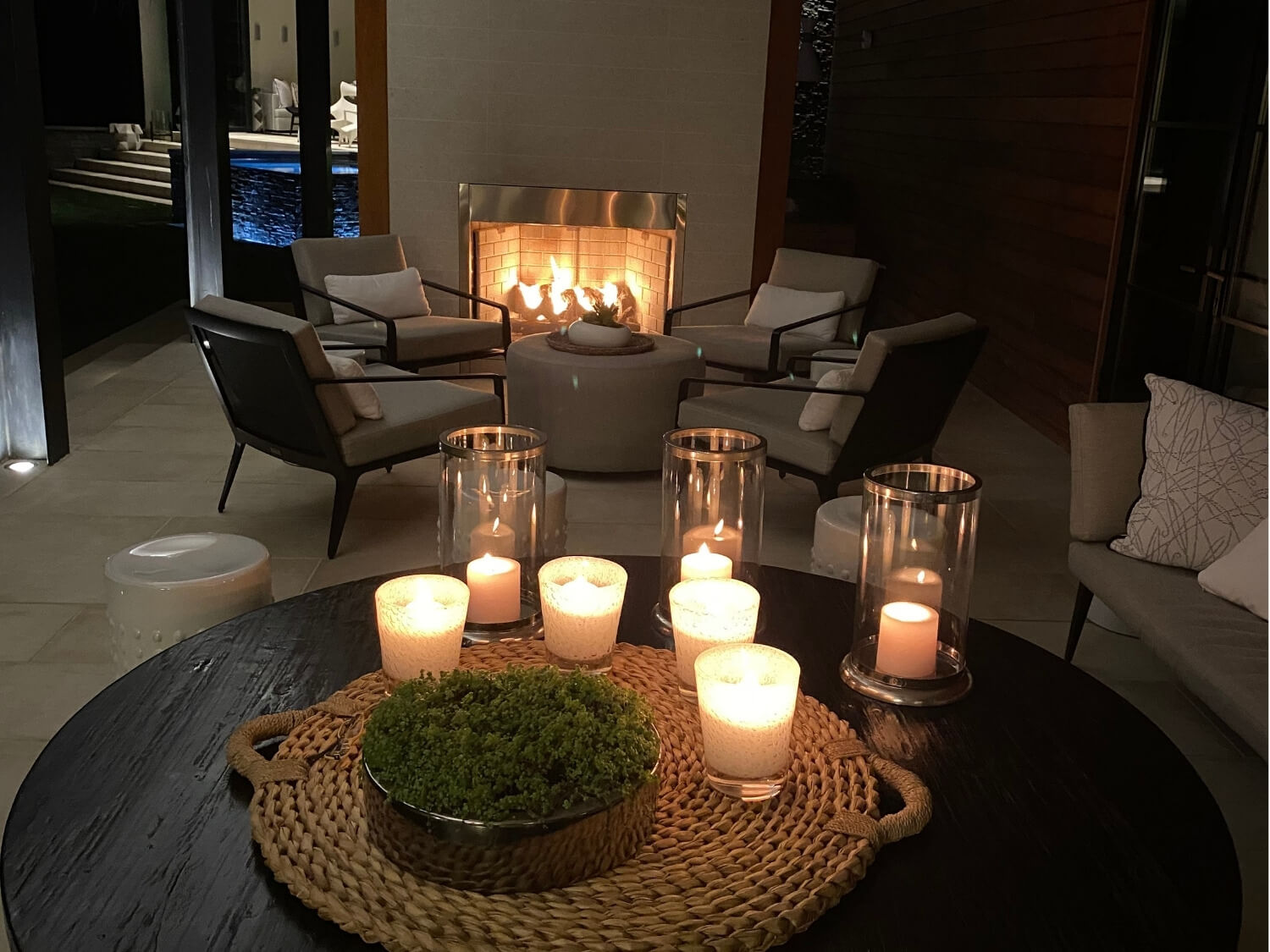
No overhead light here, just layered candlelight at different heights.
Color temperature matters more than most people realize. Stay between 2,700 and 3,000 Kelvin. Go higher, and the room starts to feel clinical, more office than dinner party. Most warm-white bulbs already sit in that range, but check anyway. A single cool-toned bulb in an otherwise warm room stands out immediately, and never in a flattering way. It is worth reading more on how Kelvin temperature shapes a room's mood if lighting is new territory.
Then think in layers, not sources. One lamp is not enough, and neither is one candle. A sideboard lamp, a low cluster of candles at the table's center, maybe something closer to the floor if the room has the space for it, three or four points of light instead of one, and the shadows soften on their own. The room gains a depth it did not have a minute earlier.
Candles carry most of this work, so placement matters more than quantity. Keep the flame either well below eye level or well above it once guests are seated. It is the flame sitting right at eye level, glowing directly between two faces, that ruins a conversation. Group candles in odd numbers: three votives read as intentional, two reads like an afterthought. Vary the height, too. A tall taper next to a low tealight throws off a flicker pattern that a row of identical candles simply cannot. The Hewory glass candlestick holders work well for this kind of height contrast, and the Volens gold tealight holders add a warm metallic note without competing with the flame itself.
Keep the flame below or above eye level, never at it. A candle glowing directly between two faces at the table is the single most common lighting mistake at a dinner party.
For rentals or homes with fire restrictions, flameless LED tea lights give the same flicker without the risk, and they are realistic enough now that most guests will not notice the difference. Dimmers help enormously if the space has them. If your space does not, a dimmable lamp or two is one of the cheapest upgrades a dining room can get, right alongside the basics covered in how to host a dinner party if you are starting from scratch.
Scent: The Layer Everyone Forgets
Nobody plans a dinner party around scent. That is exactly why it is the layer that separates a beautiful room from a memorable one.
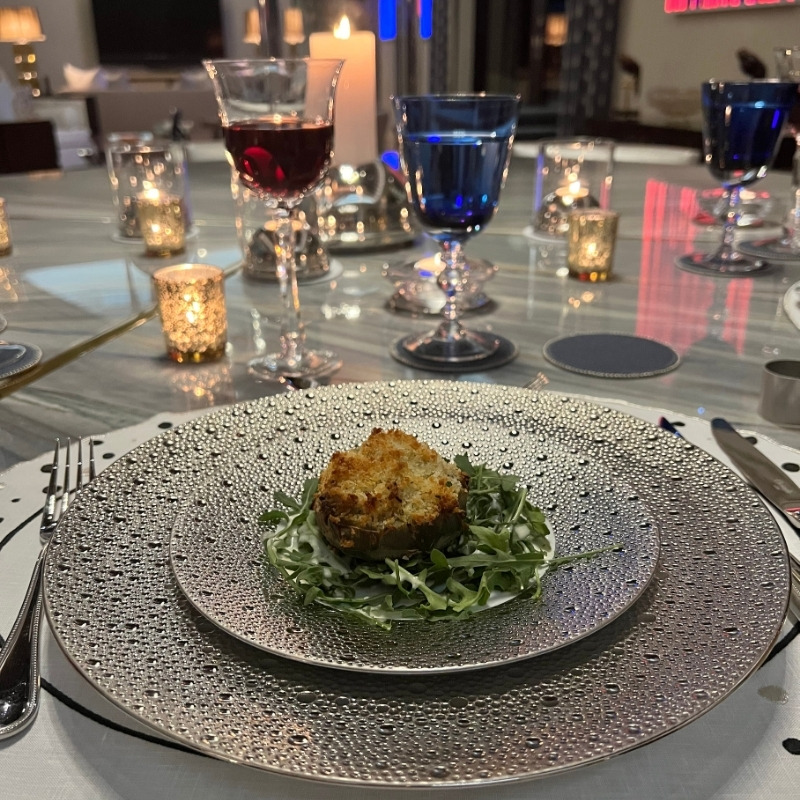
Keep fragrance off the table itself once food is served.
Timing matters more than the fragrance itself. Light a candle or run a diffuser at least thirty minutes before guests arrive, never as they are walking through the door. Fresh smoke or a fragrance in its first few minutes reads as artificial, even alarming. It announces itself instead of simply being there. Give it time to settle into the room, and by the time anyone notices it, it will already feel like it belongs.
Choose one scent family and stop there. Layering three different candles across a room, citrus in the entryway, something woody on the console, florals near the table, creates confusion instead of atmosphere. Pick a single direction: warm and woody for a fall dinner, green and herbal in summer, something soft and slightly sweet for a winter evening. One scent, chosen deliberately, feels considered. Three competing ones just feel like a lot of candles.
And keep it away from the table itself once food is served. This is the rule most home hosts miss. A strongly scented candle sitting six inches from a dinner plate competes with the meal, and it usually wins, which is the opposite of what you want. Move fragrance to the entry, a side console, a powder room. Let the dining table smell like the food on it. Research from institutions like the Monell Chemical Senses Center on how closely scent is tied to memory helps explain why this detail matters more than people assume.
If you are using a diffuser rather than candles, the same distance rule applies, and reed diffusers in particular need more lead time than a candle, closer to an hour before guests arrive, since the scent builds gradually rather than all at once.
Sound: Designed, Not Just Playing
Most people press play on a playlist and consider the job done. It is not. Sound changes across an evening the same way light and scent do, and treating it as one static background track is the easiest way to lose an atmosphere you spent hours building.
Push the speaker into a corner so sound wraps the room instead of pointing into it.
Start slower than feels natural. During the first thirty minutes, while guests are arriving and finding their seats, keep the tempo down. This is usually the same window when passed hors d'oeuvres are circulating, so the music should support quiet conversation, not compete with it. Somewhere in the 70 to 90 BPM range works well, instrumental or mostly-instrumental tracks, nothing with lyrics competing for attention.
Once everyone is seated and the meal is underway, the tempo can climb slightly, but not by much. This is the stretch where the room is loudest with actual conversation, so the music's job is to fill silence, not compete with it. Volume matters here more than genre: if you have to raise your voice to be heard by the person next to you, it is too loud, regardless of how good the playlist is.
Placement of the speaker matters as much as the playlist itself. A single speaker aimed directly at the table puts sound right where conversation is happening, which works against you. Push it into a corner, or better, use two smaller speakers on opposite sides of the room, so the sound wraps around the space instead of pointing into it. A compact option like the TRIBIT StormBox Mini+ is easy to tuck into a corner or shelf without it becoming a visual focal point, especially if it is sharing space with a styled bar cart nearby.
Save any upbeat, higher-energy music for after dinner, once plates are cleared and people naturally start moving around. That is the one moment in the evening where a livelier tempo actually helps rather than intrudes.
The best atmosphere is the one nobody notices — guests just feel like they can stay a little longer. That's not decoration. That's engineering.
Ask the Florist: Eka Dara on Flowers as Part of the Atmosphere
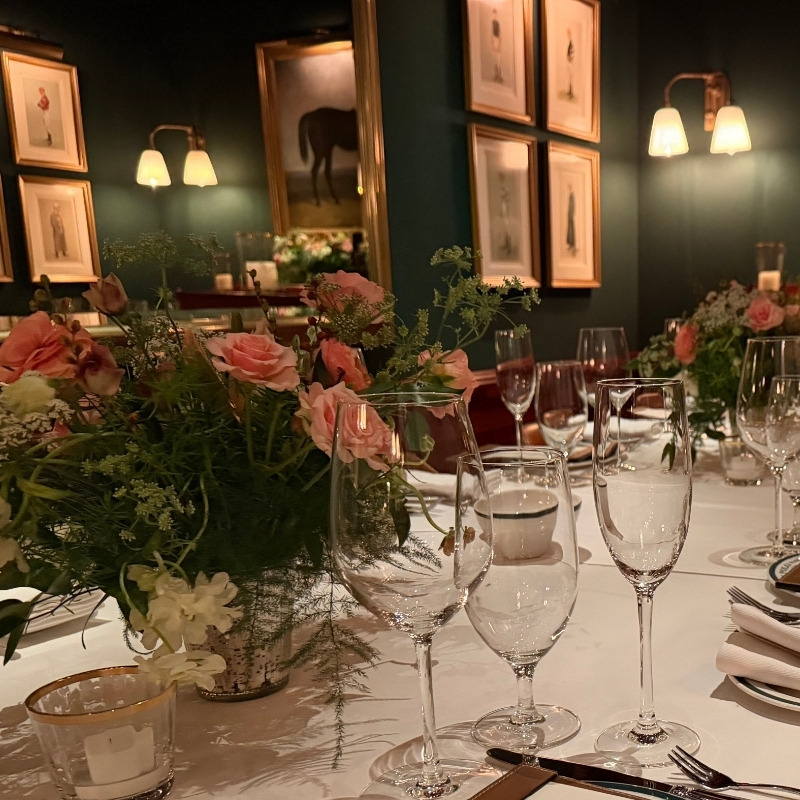
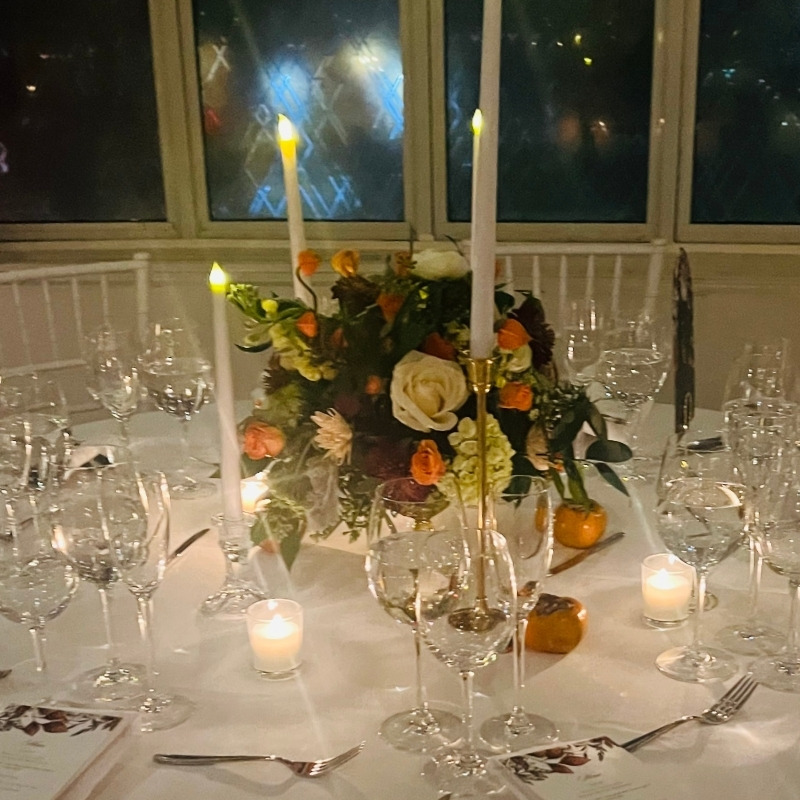
Low and loose keeps sightlines open. Floral design by Eka Dara, Edelweiss Floral Atelier.
Eka Dara · Florist & Owner, Edelweiss Floral Atelier, Cobble Hill, Brooklyn
Me: Do flowers actually belong in a conversation about ambiance, or are they just decoration?
Eka: They're part of the same system as light and scent. A tall, dense centerpiece blocks sightlines, and people end up talking around the flowers instead of to each other across the table. Low and loose works better here, especially on a table where the plates themselves are already doing visual work, the kind of layered look covered in mixing and matching dinnerware. Save anything tall or sculptural for a console or an entry, somewhere people walk past, not somewhere they sit across from for two hours.
Me: Does the flower choice need to match the scent in the room?
Eka: It should complement it, never compete with it. If there's already a scented candle on the table, choose flowers with little fragrance of their own: ranunculus, garden roses, dahlias. Fragrant stems like tuberose or gardenia belong somewhere without a competing scent source, an entryway works well.
Me: What's one thing people get wrong with flowers for a dinner party?
Eka: Buying them the same day. Flowers need at least a full day to open and settle into their final shape. Buy them a day or two ahead, let them come up to room temperature before arranging. A flower still tight and cold-shocked from the shop never looks the way it will 24 hours later, and by then, it's usually too late to fix.
Frequently Asked Questions
How do you create ambiance for a dinner party?
How does a professional event stylist approach dinner party ambiance differently than a typical host?
What is the single most important element of dinner party ambiance?
How early should I light candles or start a diffuser before guests arrive?
Should music have lyrics during a dinner party?
Can I use flameless candles and still create the same effect?
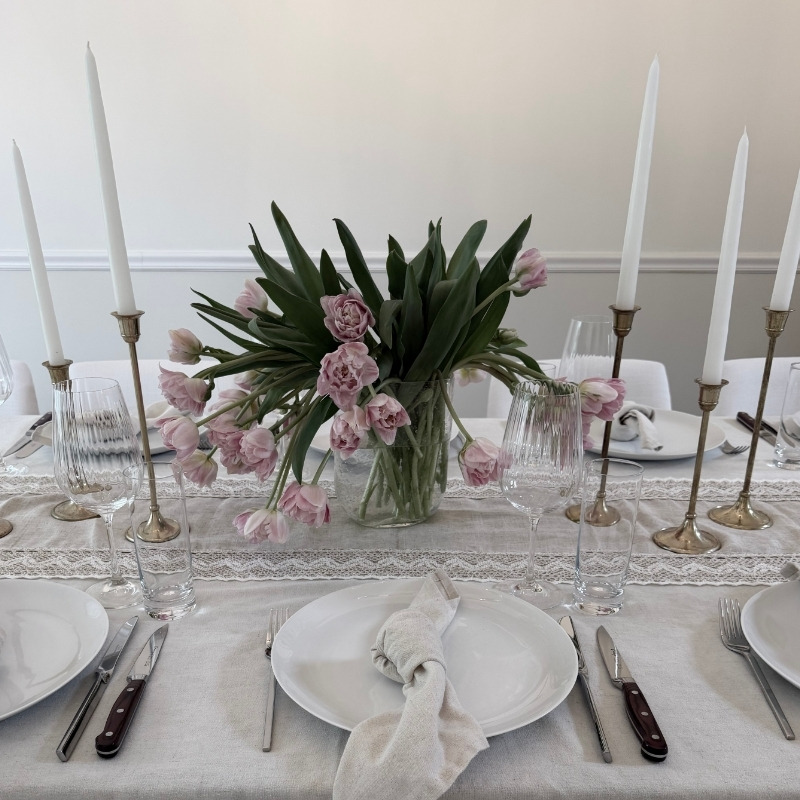
The finished result of layering light, scent, and sound as one experience.
None of this is complicated. It just requires attention that most hosts skip. Turn off the overhead light before guests arrive. Let a candle burn for half an hour before anyone walks through the door. Choose one playlist, and let the volume stay low enough for conversation to win.
What ties it together isn't any single choice — it's timing. Learning how to create ambiance for a dinner party is really just learning that light, scent, and sound each work on their own schedule.
Turn off the overhead light. Light the candle early. Then go enjoy your own party.