
Why I Stopped Matching Everything at the Table
This post may contain affiliate links. As an Amazon Associate, I earn from qualifying purchases, at no extra cost to you.
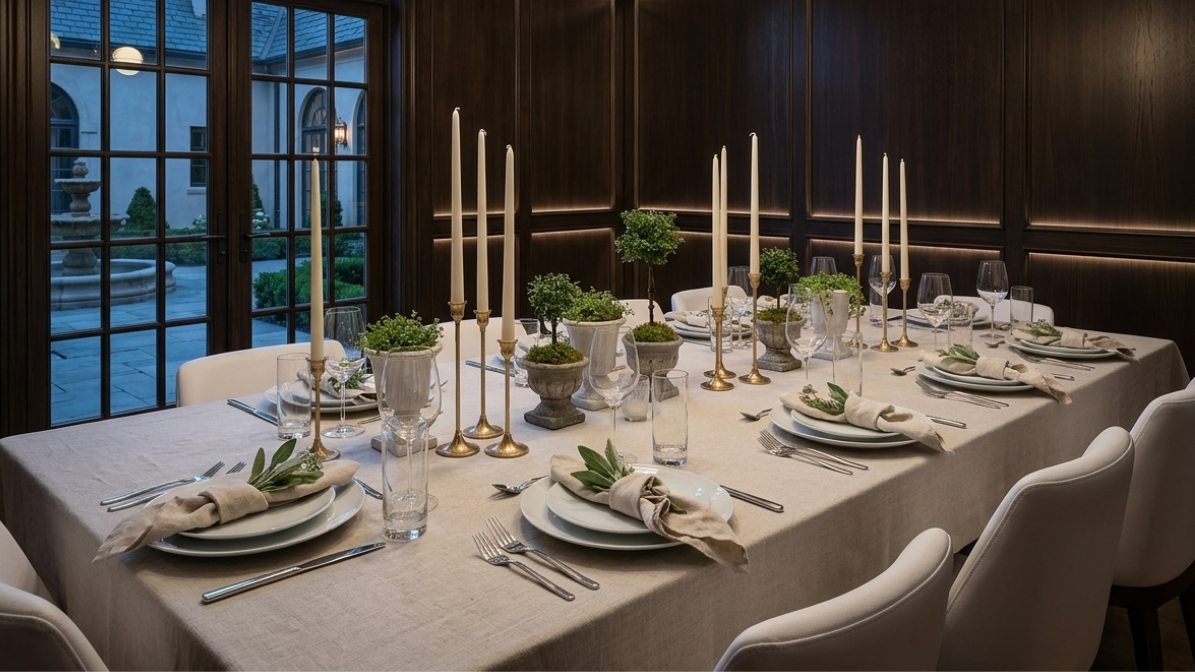
The secret to a beautiful table is not buying a perfectly coordinated set. It is learning to mix with intention. A mix and match dinnerware approach lets you combine pieces that relate through color, texture, or proportion rather than rigid sameness, creating a table that feels personal, collected, and alive.
Every dinner table I styled, for years, felt like a choreographed performance of symmetry. The plates spoke to the linens, the linens nodded to the glassware, and every fork sat at a precise right angle to the table's edge. It was beautiful, but it was also a kind of museum: a place where the fear of a mismatched bowl could grow louder than the conversation itself.
I stopped matching everything when I realized that a perfect table often leaves too little room for the imperfect people gathered around it. Fifteen years of styling tables taught me the rules well enough to break them. Mix and match dinnerware is not a compromise. It is a choice. Balance matters more than coordination, and a table should feel collected rather than assembled.
This is what that shift looks like in practice.
Why a Perfectly Matched Table Can Work Against You
If the real heart of a dinner is connection, a perfectly matched table can, paradoxically, be the very thing that stands in the way. We often lean into a seamless look because we think it shows we care, but to a guest, that level of precision can broadcast a different message: fragility.
By introducing the "mismatched," the flea-market find beside the heirloom, the dinner table begins to reflect a life actually lived. Shifting away from uniformity is not a lapse in taste. In some ways, it comes closer to the spirit of Wabi-Sabi: the idea that beauty often lives in imperfection, irregularity, and things that feel lived with rather than finished.
The Museum Effect
When every plate is a mirror image of the next, you accidentally create what I call the Museum Effect. Think about the last time you walked into a room where everything was surgically placed. You probably instinctively tucked your elbows in.
I remember hosting a dinner where I had spent hours ensuring every gold-rimmed plate aligned perfectly with the napkins. Instead of a relaxed evening, I noticed my friend hovering her bread over her plate like it was a delicate artifact, terrified a crumb might ruin the "set." The table was so controlled that she felt she had to be controlled, too.
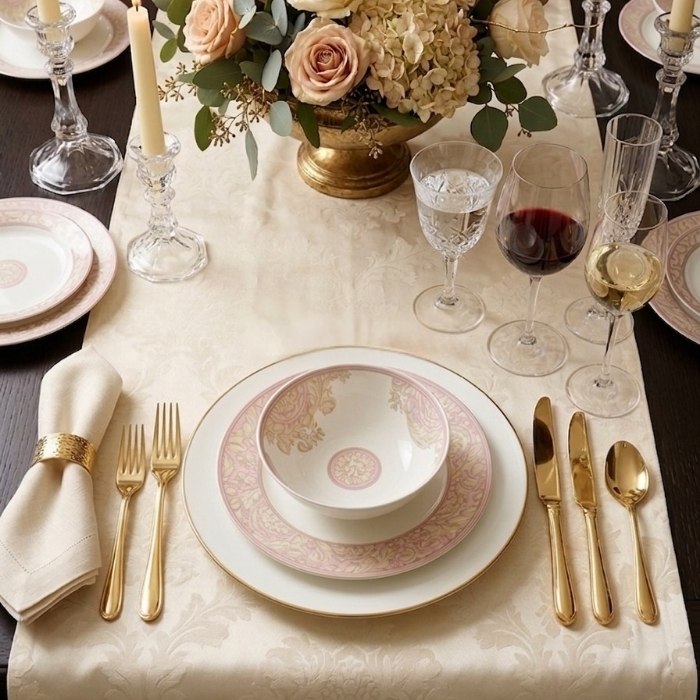
Every detail coordinated, every piece in place. Beautiful, but would you reach for the bread?
Photo by MyHomeShelf.com
A matching set is a snapshot of a single moment: the day you bought "The Collection." What it often lacks is narrative. A bowl found in a small shop in Lisbon. Heavy glassware inherited from a grandmother. A ceramic plate that caught your eye on an ordinary Tuesday. These are the pieces that give a table memory.
When everything matches, the table becomes anonymous. When it does not, the table becomes a conversation.
What I Mix on Purpose
Once you let go of the idea that everything must come from the same box, a table starts to open up. Pieces begin to relate to each other instead of simply repeating each other. That is where the real styling happens.
Here is what I have learned after years of setting tables for events and private dinners across New York City.
Dinnerware. A white dinner plate is one of the most versatile pieces you can own. It works as a quiet backdrop for almost anything: a hand-painted salad plate on top, a textured charger underneath, a bold napkin to the side. Whether you choose bone china or porcelain, the principle is the same. You do not need a full matching dinnerware set of eight. You need a reliable base and the freedom to layer something unexpected over it. This is the core of mix and match dinnerware: one steady element that holds the table together while everything else tells a story.
Glassware. Tall crystal stemware next to a simple tumbler is one of the easiest contrasts to create, and one of the most effective. The shapes play off each other, the light catches differently, and the table feels intentional without feeling forced. I often mix clear and tinted glass on the same table, especially when the rest of the setting is neutral.
Napkins and textiles. A crisp linen napkin folded simply beside polished china creates a beautiful tension between formal and relaxed. You do not need napkins that match your tablecloth exactly. In fact, a slight contrast in texture or tone often makes both pieces look more interesting.
Flowers. A single stem in a small vase next to a formal place setting can do more than an elaborate centerpiece. Flowers bring the one element a table cannot create on its own: something living, something imperfect, something that will not be there tomorrow. They work best when they complement the mood rather than compete with the dinnerware.
The tables that stay with people are rarely the ones where every piece was purchased together on the same afternoon. They are the ones that feel gathered over time, where a flea-market find sits comfortably beside an heirloom, and neither one looks out of place.
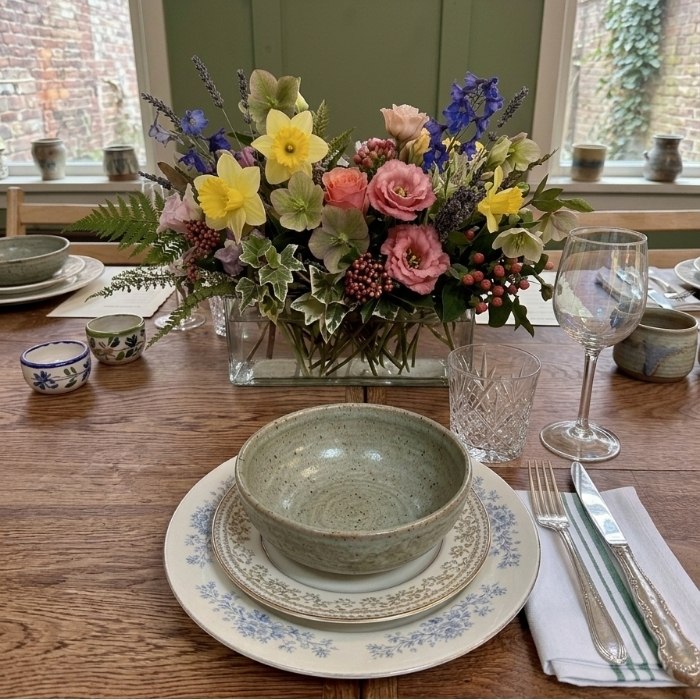
A handmade bowl, a vintage plate, a crystal glass beside a simple one. Nothing matches. Everything belongs.
Photo by MyHomeShelf.com
Balance Is Not Randomness
When I talk about breaking the set, I do not mean inviting chaos to the table. There is a common misconception that if you are not matching, you are not thinking. But the truth lies in the space between the rigid "boxed set" and a pile of random objects.
Think of it like a good guest list. You would not invite ten people who are exactly the same; that would be a boring conversation. But you also would not invite ten people who have absolutely nothing in common and will spend the night in awkward silence. You look for a mix of personalities that work well together. Once you've curated your mix, the next step is knowing exactly how to set a table that shows it all off beautifully.
When you mix with intention, the table looks assembled rather than purchased. It shows your guests that you have put thought into the composition, but you are not a slave to the rules. It shows that you trust your own eye, enough to place a handmade Georgian bowl beside a sleek Scandinavian plate and let them belong to the same story.
This is what interior designers often call the "collected" look: a space (or a table) where every piece feels chosen, not just purchased in one trip. It is the difference between a table setting that tells a story and one that simply fills a surface.
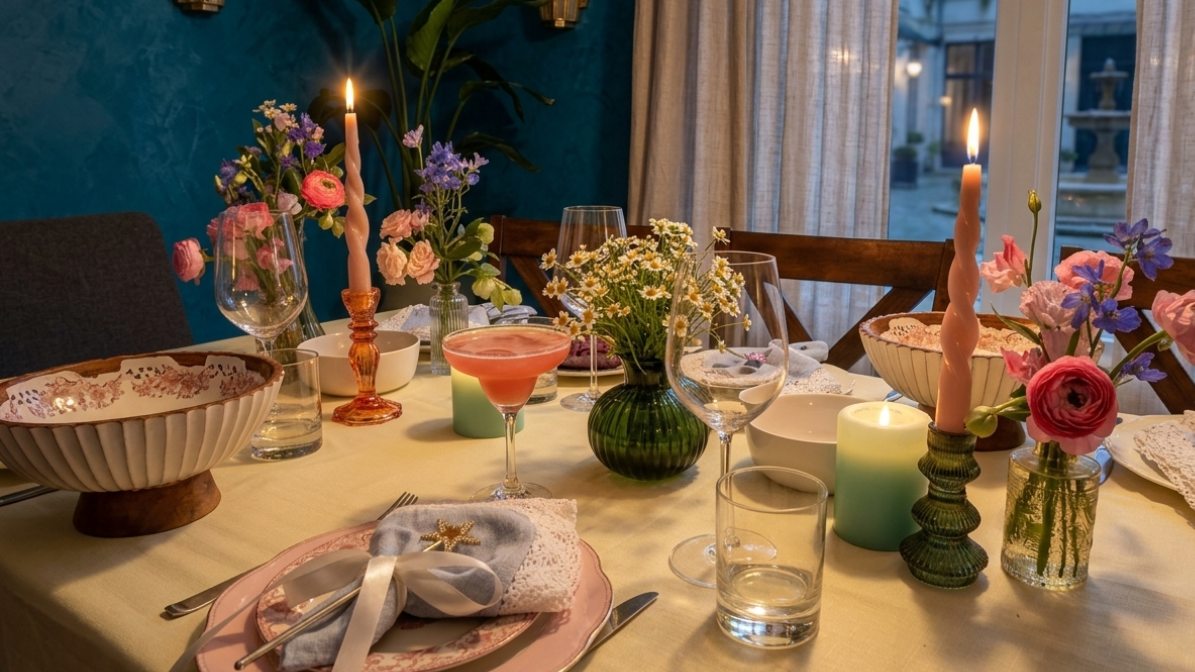
A table that feels gathered, not purchased. Intention without rigidity.
Photo by MyHomeShelf.com
Rule of thumb: Start with one anchor piece you love, whether that is a dinner plate, a tablecloth, or a vase. Build around it with no more than two or three colors. Repeat at least one small element across the table (a material, a shape, a finish) to create rhythm. And leave space. A table needs room to breathe just as much as a conversation does.
Frequently Asked Questions
How do I start mixing dinnerware if I only own one matching set?
Does mix and match dinnerware look messy?
What colors work best for a mix and match table setting?
Can I mix expensive and inexpensive pieces on the same table?
How many different patterns can I use on one table?
Is mix and match dinnerware a trend or a lasting style?
A table does not need to be perfect to be beautiful. It needs to feel like yours. Collected, balanced, alive with the kind of small imperfections that make a guest reach for the bread without thinking twice. That is what mixing with intention gives you. Not a showroom. A home.